The World of Mwylunnus
The Future: 4074 C.E.
⟳ Table of Contents
- Introduction
- Getting started
- Universe
- Cosmography
- Intergalactic travel
- History
- Timeline
- Events
- Culture & Society
- Language
- Technology
- Architecture
- Species
- Sapient species
- Companions
Introduction
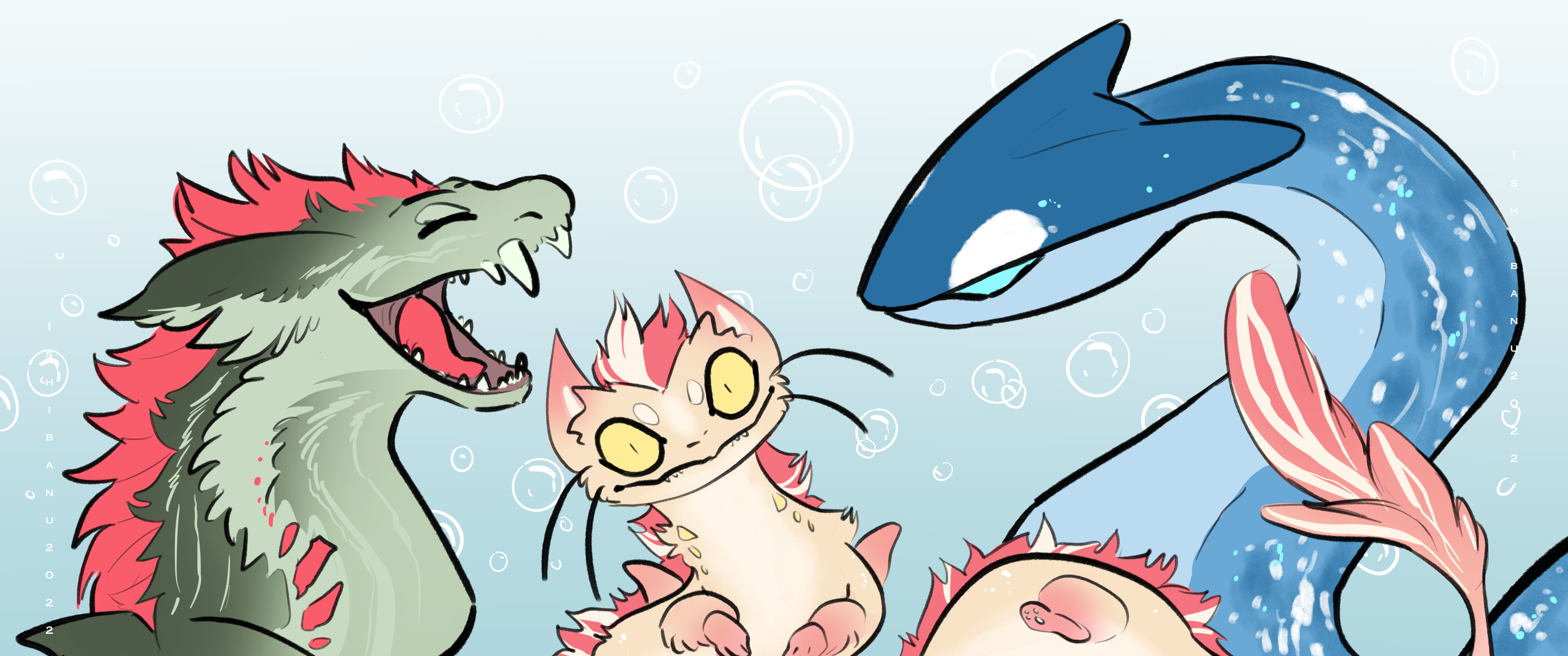
Humans have long since taken off from Earth to explore the universe beyond, and yet still continue to advance Earth even further, burying it in a jungle of advanced tech. Out into open space the explorers went, where their fleets of few met a multitude of other sentient species. Amongst those species are Djubetos. It's a harsh world of open space, explorer fleets, aliens, and planets. ships of various species war against each other, yet, despite their differences, they all unite in their caution against Djubetos.
Getting Started
wip
Universe
Cosmography
wip
Intergalactic Travel
wip
Hyperjumping: The process of cranking ship engines up into an overdrive move to travel faster than light speed in order to quickly traverse long distances. It can be hard on ship engines and sometimes takes a while to calibrate before doing in order to avoid collisions, but to this day remains a relatively common method for travel - especially when photon reactor core engines are unavailable.
Parallel Jumping: Parallel jumping was discovered by an organization called the PUP (Parallel Universe Project), and quickly overtook hyperjumping as a main method for long distance travel. It involves ships with photon reactor core engines harnessing the energy from special crystals called photons (more formally known as vesushikain) to open a tear called a jumpgate and dip shallowly into the dimensional barrier between Mwylunnus and the Otherworld and "jump" back out in a different location. Humanity does not yet have the technology to break fully through the dimensional barrier, so info on the Otherworld is slim. This travel method is incredibly popular due to nearly instantaneous travel time after the initial calibration is complete and the jumpgate is opened.
The gates work by stimulating the photon within the engine to create an energy surge powerful enough to fracture the dimensional wall. Individual ships with this style of engine may either create an independent jumpgate at risk of collision upon exiting, or calibrate their entry port to a pre-existing commercial gate. Longer distance jumps require a higher energy surge and thus have a longer cool down time in order for the photon to recharge. Ships that jump long distances frequently may have more than one photon in their engine in order to either rotate them for cooldowns or use them in tandem for incredibly long distance parallel jumping.
The IAB quickly commercialized the concept by creating a vast network of "jumpstations" across the universe with countless interconnected routes and permanently opened gates. Most inhabited planets have at least one commercial jumpgate that connects to one of these IAB stations, so interplanetary travel has become increasingly accessible. Planets that do not have a designated planetary jumpgate such as Phirus E4 rely on freight ships that have reactor core engines to generate jump gates in order to access these stations. All it takes is sending a request signal to the station in order to join the exit or entry queue to a specific gate. This method has proven highly successful in avoiding collisions.
Risks of Interdimensional Travel: A badly calculated calibration may result in an exit port in a bad location such as inside celestial bodies, or result in collision upon exiting. The commercial jumpstations have mostly eliminated this issue, but problems still arise when unlicensed ships trying to stay under the radar independently open jumpgates rather than using the stations.
Ships with faulty photon reactor cores also cause issues, as too large of an energy surge may cause an unstable jumpgate that pulls surrounding debris into it. Too small of a surge and the gate risks closing in on itself before the ship is able to exit. To prevent this, regular maintenance must be performed on the core and proof of maintenance and inspection must be presented yearly to the IAB.
Photonic energy is incredibly dangerous to humans, and thus photons and photon cores should not be handled directly. Those who work with them must be screened yearly for a buildup of the energy in their blood to prevent photon poisoning. Early symptoms include insomnia, mania, aggression and delirium as the body tries to burn off the excess energy. Those in early stages of photon poisoning report an "itching" sensation under their skin as the energy burns into nerves. If patients aren't able to burn off the excess, then it progresses into advanced poisoning which results in severe fever, irreversible brain damage, hot flashes and death.
Rogue Rifts: Occasionally a rift will appear. These are "jumpgates" that have torn all the way through the dimensional barrier. They are incredibly dangerous as it seems that the Otherworld is saturated in photonic energy which leaks through these rifts in lethal amounts. Humanity does not have the technology to open such rifts, but they do have measures to "encourage" the rift to close on its own in time. Occasionally a djubetos will be sent through a rift for the sake of research. They seldom come back, but those who do often refuse to speak about what they saw on the other side. Djubetos who pass through rifts frequently have a tendency to develop an affliction called Unstable Actuality, where their very being becomes "glitched" and torn between the two worlds.
Occasionally creatures and items from the Otherworld pass through rifts - all of which are prized by researchers and collectors for their rarity. It's theorized that long ago, the evolutionary ancestor of djubetos themselves came through the rifts into Mwylunnus. This theory stems from the plasma in djubetos tails having a similar energy signature and volatility to photonic energy. Djubetos who survive energy surges will even form and shed photons from their tails as a way to encapsulate the surge and prevent it from damaging their body. They also have a much higher tolerance to photonic energy and are often hired to handle photon reactor cores.
Very, very rarely, a djubetos will be born with vesushikain within their horns. These djubetos can learn to harness photonic energy in ways beyond what science can explain, and can even learn to open jumpgates and rifts with their horns. The PUP is highly interested in the concept of these rift horns and even ran a research project about five years ago to study djubetos mutation in hopes of finding a way to mutate these horns onto existing djubetos, but it seems as though it's not possible to obtain via mutation factors and is suspected instead to be hereditary. However, they haven't been able to get their hands on enough rift horned djubetos to prove this theory or isolate the gene that causes it.
History
Timeline
wip
Major Events
wip
Culture & Society
Language
While most planets have their own language, after the convenience of parallel jumping was discovered, the IAB introduced commonspeak, a universal language to bring all societies together. While it was unpopular at first, commonspeak took off rather quickly as the most commonly spoken language in the universe. It's taught as a second language on most planets and used in most interplanetary interactions.
Of course, for instances where commonspeak is not relevant, an auto-translation feature is coded into most modern holocoms, allowing for easy communication in any situation. Some holocoms have even been programmed to pick up on and translate djubetos hornspeak!
Technology
wip
Architecture
wip
Species